
Reading vs. Studying: Why We Need Both
Because they aren't the same.


Reading is rapid.
Studying is slow.
These are not truisms
So please don’t quote me.
We want to be people who both read and study the Bible. Reading quickly familiarizes ourselves with the contents while studying helps us to rightly understand the contents. Our goal is both familiarity and understanding.
Pastors will sometimes say from the pulpit, “Don’t just believe what I say; study it for yourself.” And while that’s good advice, how do we actually do that?
Let’s define our terms.
READING VS. STUDYING
Reading and studying the Bible aren’t the same. Think of reading a novel at the beach versus studying a textbook. Reading is relaxed and broad; studying involves highlighters, notebooks, and attention to detail. Phylicia Masonheimer compares reading to flying over a city in a helicopter, where you see the whole layout. But studying is like walking its streets, where you notice the specifics.
Both are essential for the Christian life, but they serve different purposes, so it’s helpful to distinguish between them.
READING
Reading would mean, well, reading. It could be working through a Read the Bible in a Year (or Three) program or alongside a devotional book. In my mind, reading is more like fellowship with God.
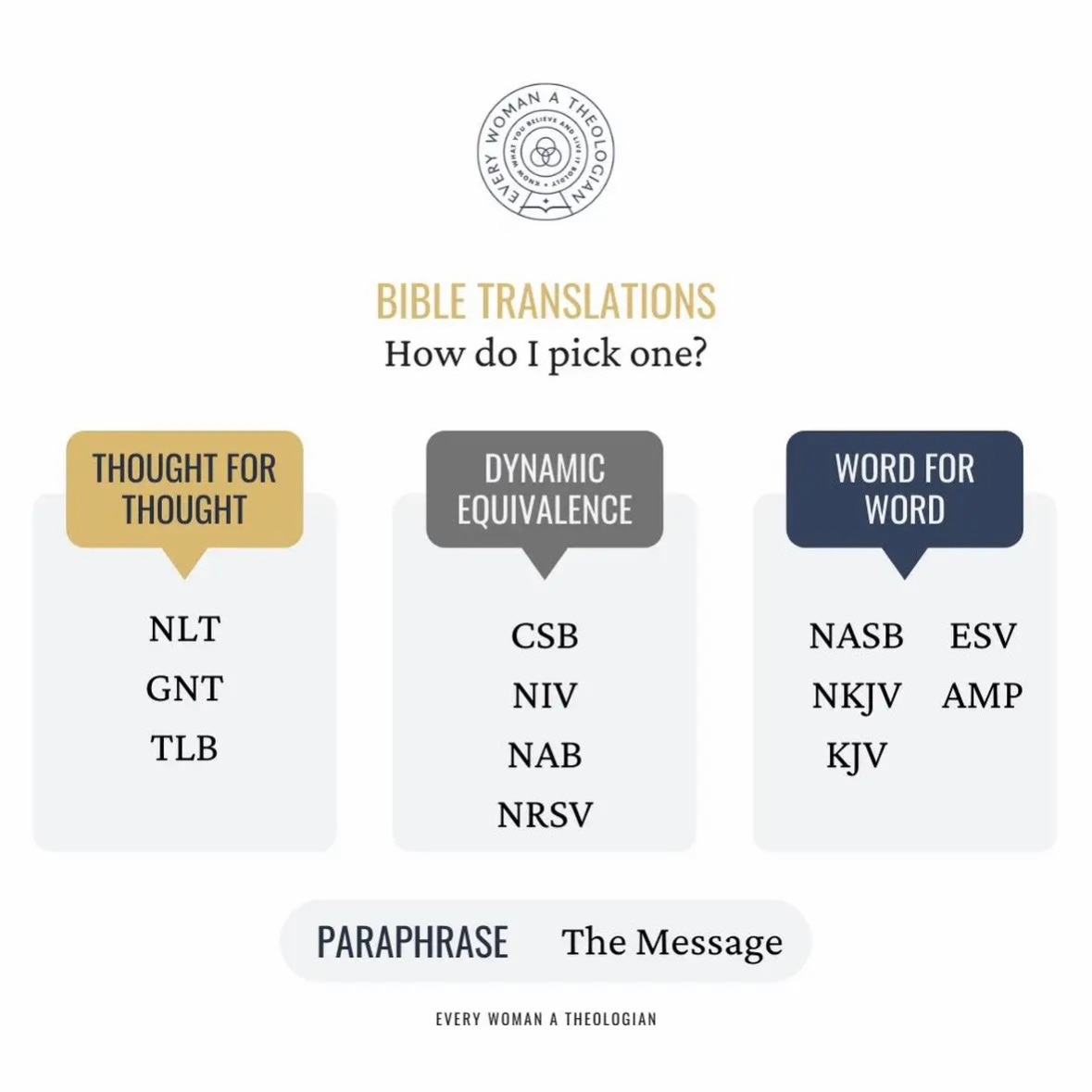
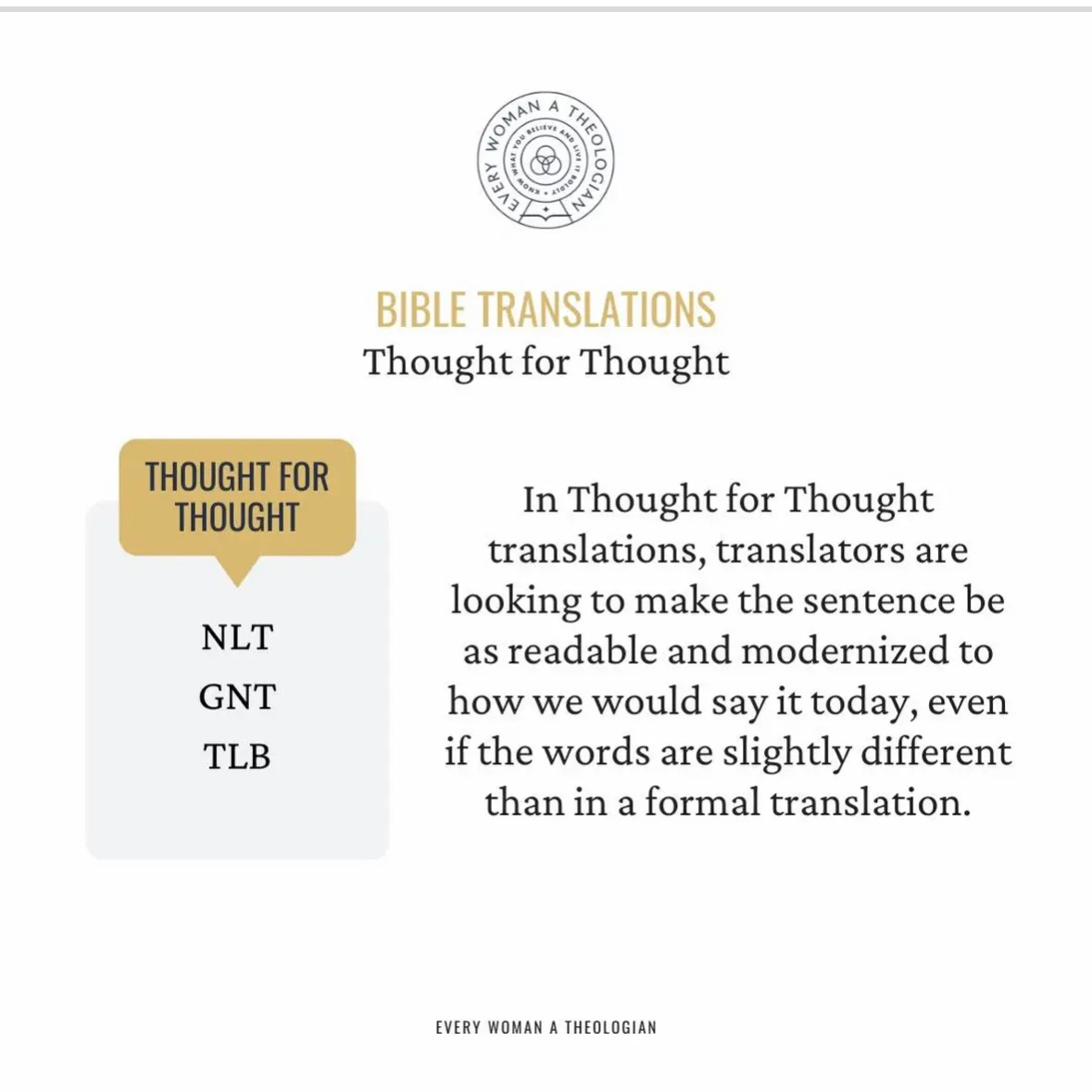
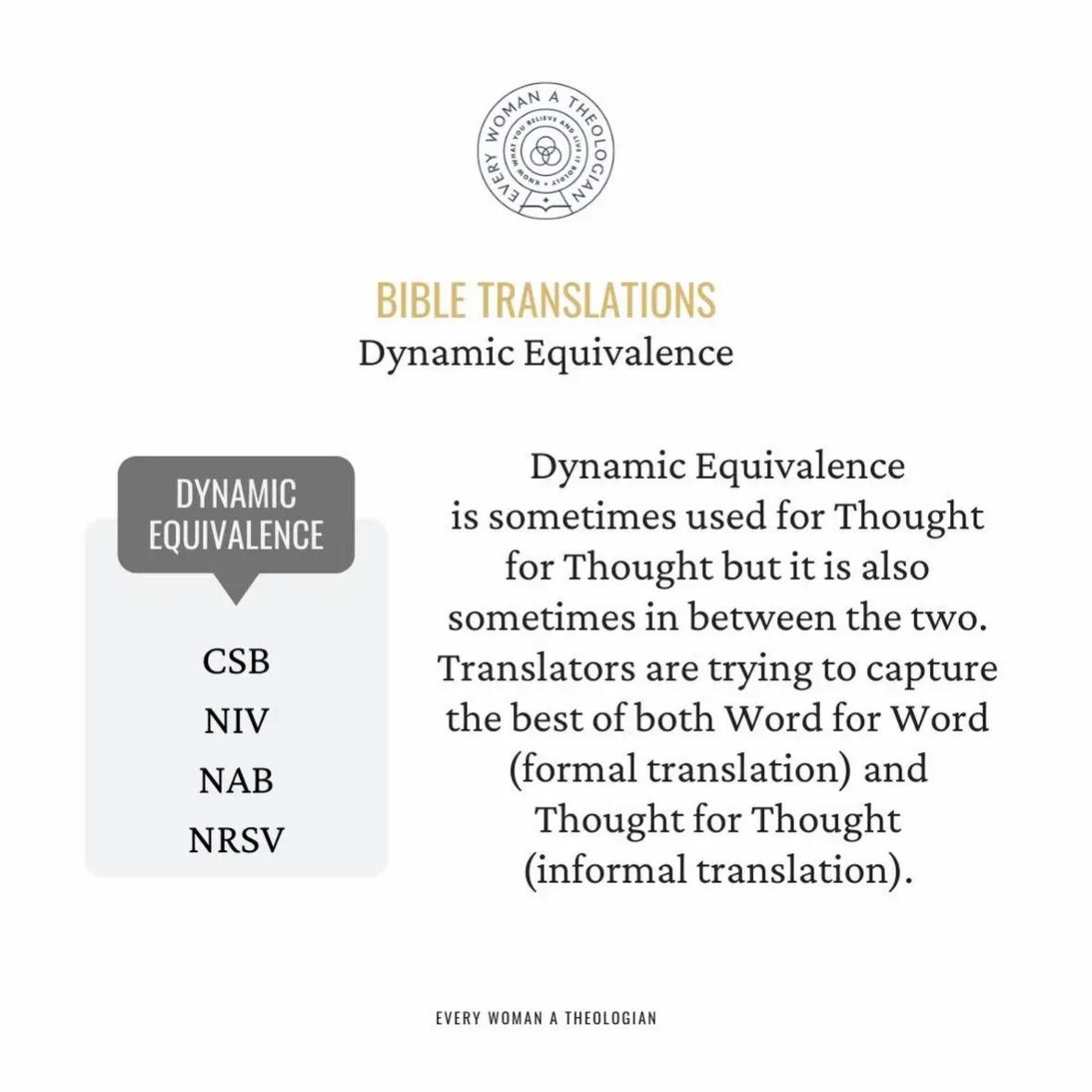
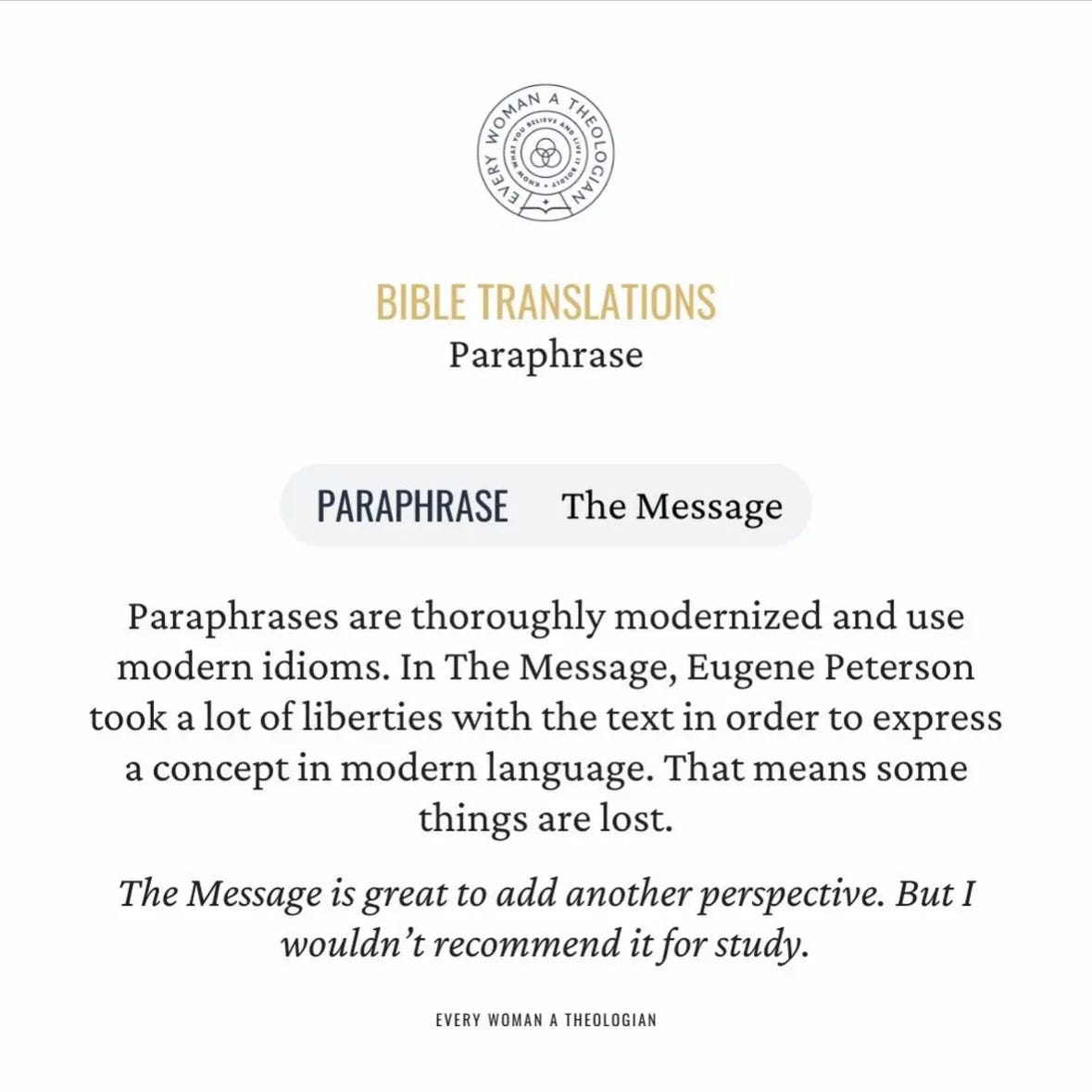
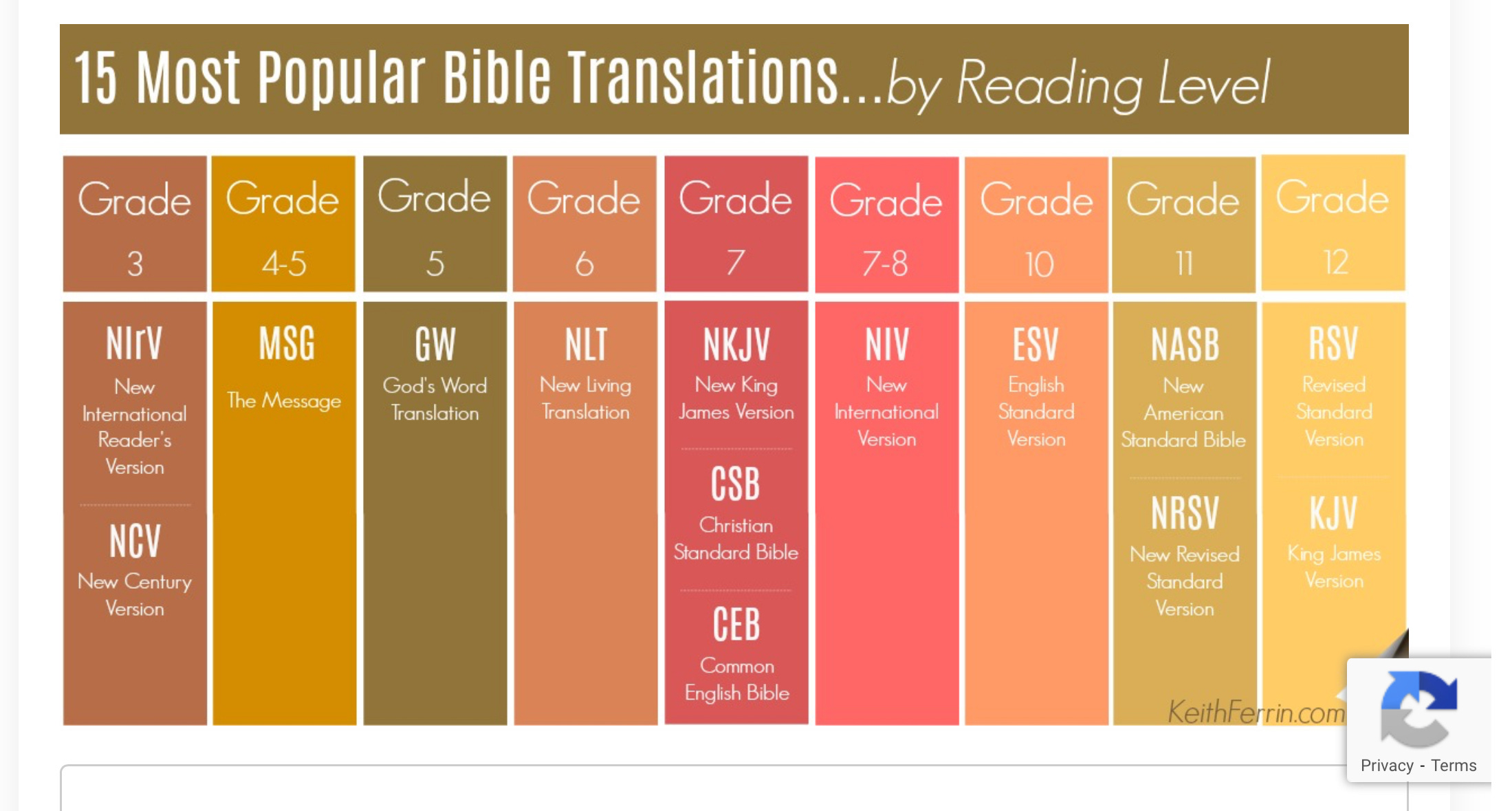
Great reading translations include, the New Living Translation, and the New International Bible. These are easy to read but are not precise enough for study.
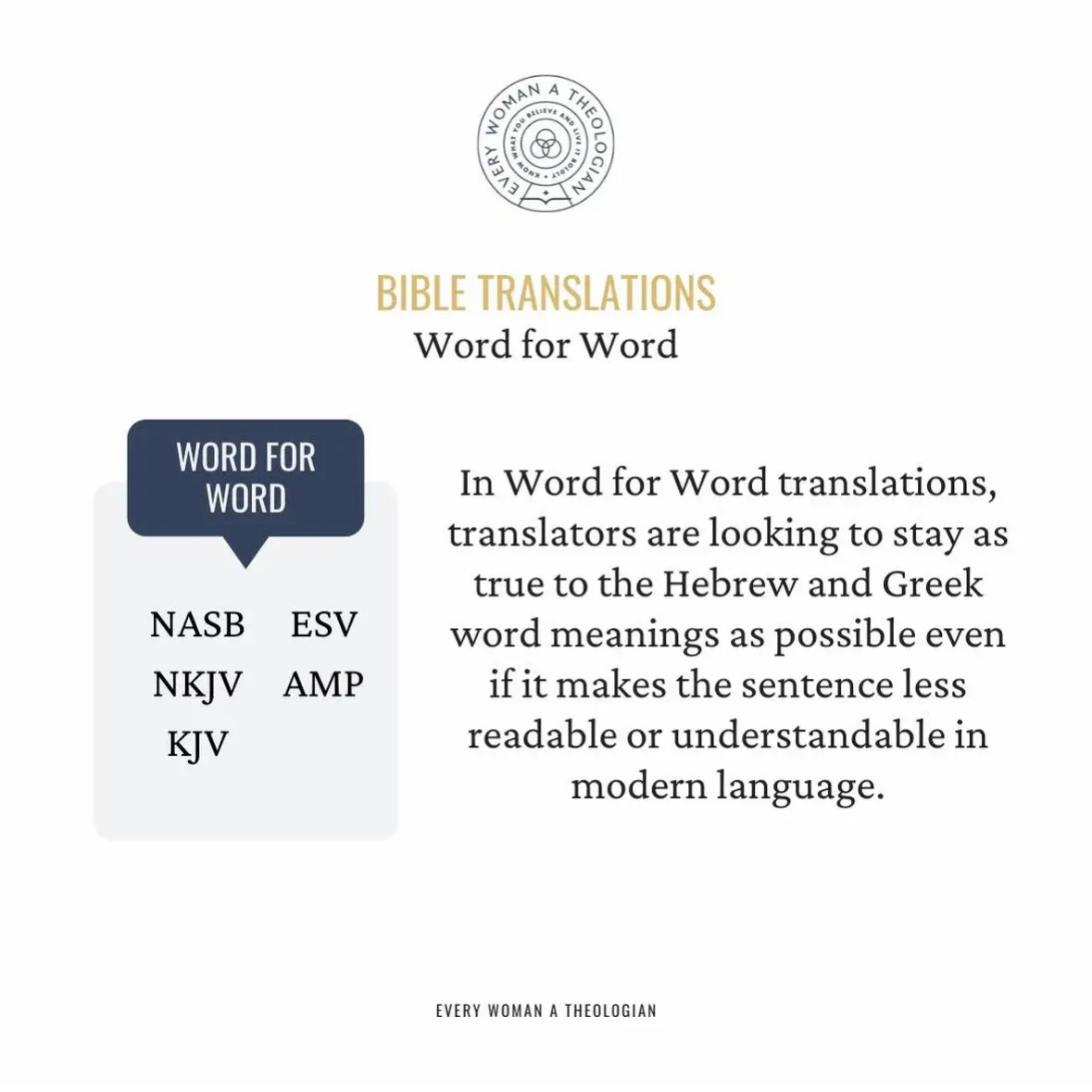
Here are some helpful images from Phylicia Masonheimer of Every Women a Theologian and Keith Ferrin.
STUDYING SHORT VS. LONG BOOKS OF THE BIBLE
Studying, on the other hand, is focused on the great Themes and Types of the Bible. It examines what we believe and why we believe it. Studying prepares us to give a defense for our faith and great hope.
A simple way to study a short book—like Galatians—is to read it every day for about a month.
First, read it quickly, without overanalyzing, just to become familiar with it. After about a week, more or less, start studying. We want to have the Big Picture of the book in mind before to start looking at the components. (This would be in addition to your “Quiet Time”).
For longer books, read as many chapters as you can each day, aiming to finish the book several times over the course of one to two months. Then over the next two months, begin studying. Studying longer books requires a longer time commitment— maybe 4-5 months.
I’d recommend the New American Standard Bible, English Standard Bible, and Christian Standard Bible. And for study, you might want all three to see how the different translations treat a verse or passage.
The absolute best way for a lay-person to get to ancient texts themselves is to go to www.blueletterbible.org. There each word or two-word phrase is a hyperlink so that you can click and see the word in its original language along with how that same word is translated in other passages and books.
SAMPLE SCHEDULE
Here’s an example plan:
Galatians
Days 1–7: Read the whole letter once each day.
Day 8-30: Read the whole book quickly each day, then begin marking and taking notes, starting with chapter 1.
Genesis
Days 1–31: Read the whole book as many times as possible.
Days 32-90+: Read chapters 1–5, then study chapter 1 in depth. The goal is always to study in context. Along those lines for example, when studying chapter 12, read chapters 10-15 first.
Re-reading before studying grounds you in the context. Always let Scripture interpret Scripture.
MARKING AND NOTE-TAKING
Color-coding helps make sense of the text. For example:
Triangle for names of God.
Square for the devil or his works.
Green underline for repeated words or phrases.
In your notebook, jot down the Who, What, When, Where, Why, and How—both for the book as a whole and for individual passages as is relevant.
THEMES
The Bible interprets itself without contradiction. Doctrines made explicit in the New Testament are often implicit in the Old, which is why a steady rhythm of reading and studying both Testaments will deepen your understanding of Scripture as a whole.
Broad themes that emerge across both testaments help us make sense of stand-alone passages. These well-understood themes are:
A people: God promises a chosen people throughout all of time
A land: God’s promises a land of blessing
A king: God promises a King
The nations: God promises to bring his salvation to all the peoples of the world
These themes — people, land, king, nations, promises — run from Genesis to Revelation. You’ll miss them if you only ever read a few verses at a time. But when you read whole books, or even sweep through the whole Bible quickly, you begin to see how the story holds together.
For fun, in your study books, you can keep track of how individual verses relate either to God, his people, their promised land, their king, and the nations.
We find Christ in all the Scriptures. In the Old Testament He is predicted, in the Gospels He is revealed, in Acts He is preached, in the epistles He is explained, and in Revelation He is expected.
Alistair Begg
TYPES
The Old Testament is also filled with “types”—persons, events, and institutions that foreshadow Christ and his kingdom. Typology shows that God patterned history so his people would recognize Jesus as the fulfillment of all Scripture. Here is a teeny-tiny sampling of types.
People
Adam is the first type: as the head of humanity, his failure points to Christ, the “last Adam,” who obeyed.
Abraham, father of faith, anticipates the greater seed in whom all nations are blessed.
Moses, the deliverer and lawgiver, prefigures Christ who frees from sin and writes the law on hearts.
David, the shepherd-king, points to the Messiah who reigns forever.
Events
The Exodus is central: Israel’s rescue from Egypt foreshadows redemption through Christ.
The Red Sea crossing prefigures baptism.
Wilderness wanderings model the believer’s pilgrimage.
Entry into the Promised Land anticipates final rest in God’s kingdom.
Institutions
Sacrifices, priests, and kings all serve typological purposes.
Animal offerings pointed to the Lamb of God.
Priests anticipated the one High Priest who mediates perfectly.
Israel’s monarchy revealed the need for a righteous, eternal king.
Israel as God’s Covenant People foreshadow the Church, which is composed of God’s Covenant People.
Symbols
Objects carried meaning too: the tabernacle and temple foreshadowed God dwelling with his people in Christ and the church.
Manna pointed to the true bread from heaven.
The bronze serpent lifted up in the desert prefigured Christ on the cross.
Typology is more than parallels; it’s more like shadows of the things to come.
As Augustine said, “The New Testament is hidden in the Old, and the Old is made plain in the New.”
FOOTNOTES
One of the simplest tools for study is already in your Bible: the footnotes and cross-references. (Side note: the NKJV supposedly has the most footnotes). Many Bibles include small letters that point to alternate translations, explanations of hard words, or references to other passages. Don’t ignore these.
For example, in Genesis 12:3 God promises Abraham, “In you all the families of the earth shall be blessed.” A good study Bible footnote will point you to Galatians 3:8, where Paul explains that this was the gospel in advance: God always intended salvation for the nations. Suddenly, the theme of “the nations” is no longer just a background detail but a promise that corresponds to the New Testament.
A caveat to this is these commentaries inevitably and unavoidably come with their own set of bias. Just keep that in mind as you read.
APPLICATION
Application can be tricky. Rather than jumping to behavior, first ask the Holy Spirit to show you what the passage reveals about God—who He is, what He does, and how He works. Our goal in reading should be to make much of Christ and both his accomplished work and his ongoing work he’s accomplishing now through His Spirit and His Bride.
Next, ask about what this passage says about God’s people and his Kingdom. As God’s children, we belong in his family and in his kingdom. And he has a specific mission for his Kingdom ambassadors.
Finally, we ask how this passage teaches us as members of God’s kingdom how to bring the Nations into this covenant Kingdom Family.
I'm SO excited about this! Since the end of December, I have been doing a 10-chapters-a-day reading program with a friend. A couple of months ago, I felt overwhelmed with doing that, preparing for Bible studies, and the rest of my life. I decided not only to not do that next year, but to drop a weekly activity. It was the first time I would be available to go to Wednesday evening Bible study, but was not going to commit to the preparation. What a blessing that study has been! Then one Sunday, you encouraged the reading of Galatians every day for a week and mentioned some do that for a month. I listened to it most days because I was not ready to read any more. Then I planned next year to read a shorter book every day for a month. Soon after, my friend started asking what I was planning for next year. I also wanted to get back to other study. My plan now is to follow this article and share it with my friend. I hadn't just read the Bible since I was being saved and my personal study can use this direction. Reading so much this year has been challenging, but amazing and I am looking forward to an even better experience in the new year. Thank you for sharing!